Unified LLM Fine-Tuning CLI
MLOps framework unifying multiple fine-tuning ecosystems with automatic backend selection, AWS SageMaker integration, and significant cost reduction through spot instances.
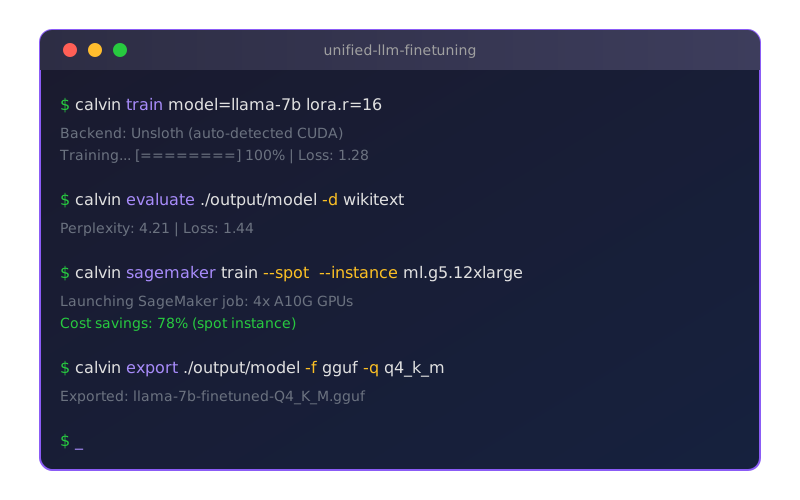
Overview
An MLOps framework that provides a unified CLI for fine-tuning open-source LLMs. It abstracts away the complexity of multiple fine-tuning ecosystems (Unsloth, TRL/PEFT) with automatic backend selection, comprehensive AWS SageMaker integration, and best practices built-in for both local and cloud training workflows.
Problem Statement
Fine-tuning open-source LLMs presents significant operational challenges:
- Ecosystem fragmentation - Engineers must learn multiple tools (Unsloth, TRL/PEFT) with different APIs
- Configuration complexity - Manual setup of distributed training (DDP, DeepSpeed), version compatibility nightmares
- Cloud training barriers - AWS SageMaker requires complex setup for multi-node training and spot instance handling
- No unified interface - Developers waste time stitching together tools and debugging integration issues
The ML engineering community needed a unified framework that provides production-grade capabilities out-of-the-box with minimal configuration.
Technical Approach
Designed a layered architecture with automatic backend selection and comprehensive configuration management:
System Architecture
Core Architecture:
- Unified CLI Interface - Single command-line tool with consistent API across all backends
- Hydra + Pydantic Stack - Type-safe configuration management with validation
- Automatic Backend Selection - CUDA available → Unsloth (optimized), CPU fallback → TRL
- Protocol-Based Evaluation - Pluggable evaluation framework supporting multiple backends (vLLM, HuggingFace)
AWS SageMaker Integration:
- Multi-node distributed training support with NCCL communication
- Spot instance orchestration with automatic retry logic (70-90% cost savings)
- Proper framework version management for gated models
- S3 checkpoint management and model artifact handling
Optimization Stack:
- DeepSpeed ZeRO stages (2, 3) for memory-efficient training
- LoRA/QLoRA with 4-bit quantization
- Gradient checkpointing for reduced memory footprint
- Sample packing for improved throughput
- Automatic chat template detection and formatting
Key Achievements
- 44 samples/sec - Achieved high throughput on 4x A10G GPUs with 4-bit quantization
- 70-90% cost reduction - AWS SageMaker spot instances vs on-demand pricing
- 10.5% loss improvement - Validated multi-GPU DDP training (1.43 → 1.28) over 3 epochs
- 2 ecosystem unification - Single interface for Unsloth and TRL/PEFT backends
- 129+ test suite - Comprehensive testing for production reliability
- Zero-config operation - Automatic backend selection based on available hardware
- 1B-70B+ model support - Memory optimization enables training large models on consumer hardware
Technologies
ML Stack: PyTorch, Transformers, Unsloth, TRL/PEFT
Optimization: LoRA/QLoRA, DeepSpeed ZeRO, 4-bit quantization, Gradient checkpointing
Infrastructure: AWS SageMaker, NCCL, vLLM
Engineering: Python, Hydra, Pydantic, uv package manager
Technical Innovations
1. Automatic Backend Selection
Intelligent hardware detection that automatically chooses the optimal fine-tuning backend:
- Single GPU → Unsloth (2x faster than standard approaches)
- Multi-GPU → TRL with DDP for distributed training
- No manual configuration required
2. DDP Data Sharding Fix
Solved critical issues preventing proper data sharding across multiple GPUs in distributed training:
- Proper
torch.distributedinitialization with NCCL backend - Automatic disabling of 4-bit quantization in DDP mode (incompatible with model wrapping)
- Correct device setup order required by NCCL
- Dynamic SFTConfig parameters for DistributedSampler integration
This fix enables true 4x speedup with 4 GPUs instead of redundant computation.
3. Protocol-Based Evaluation
Designed pluggable evaluation architecture supporting multiple backends (vLLM for fast batch inference, HuggingFace for flexibility) with custom metric implementations.
4. SageMaker Spot Instance Orchestration
Implemented robust spot instance handling with automatic retry logic, achieving 70-90% cost savings while maintaining training reliability through proper checkpoint management.
Impact
This framework democratizes LLM fine-tuning by providing enterprise capabilities in an internal tool. The framework enables researchers and engineers to:
- Rapid experimentation - Zero-config operation reduces setup time from hours to minutes
- Cost-efficient training - Spot instances make cloud training accessible
- Production reliability - Comprehensive testing and error handling prevent common pitfalls
- Ecosystem flexibility - Switch backends without rewriting configurations
The project demonstrates deep MLOps expertise spanning distributed systems, cloud infrastructure, and ML framework internals.