AI Shopping Assistant
Multimodal AI assistant that powered a 200K-user experiment, enabling natural language product discovery, offers, and rewards optimization on iOS.
Overview
Designed and deployed a multimodal AI shopping assistant that helped users discover products, find offers, maximize points, and personalize their shopping experiences across 300+ retail partners. The system powered a 200K-user holdout experiment on iOS, with intelligent, conversational interactions and sub-second response times.
Problem Statement
Fetch needed to provide users with an intelligent shopping assistant that could:
- Handle complex shopping queries - Natural language product discovery and offer optimization
- Integrate with internal systems - Seamless access to product/offer APIs and user purchase history
- Scale to production - Sub-second latency for thousands of concurrent users on mobile platforms
- Support multimodal inputs - Process both text queries and images (product recognition, fridge scanning)
- Personalize experiences - Leverage user preferences and shopping history for tailored recommendations
Technical Approach
Built a dual-service architecture with production-grade infrastructure:
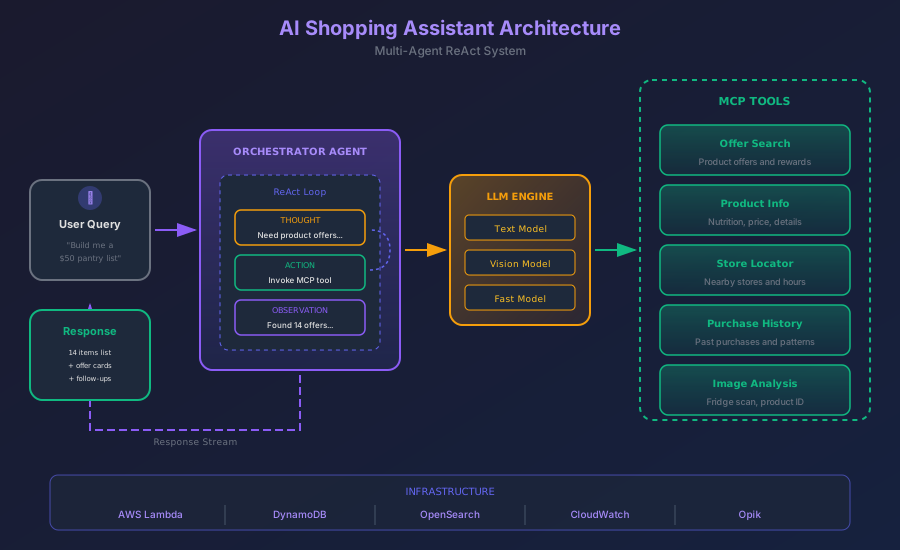
System Architecture
Architecture Components:
- Client Layer - iOS and Android mobile applications
- API Gateway Service (Go) - High-performance public-facing API handling client requests
- AI Agent Service (Python) - LangGraph-based agentic backend with ReAct pattern for reasoning and tool execution
- Tool Layer (MCP) - Model Context Protocol integration for standardized access to shopping tools
- Infrastructure (AWS) - ECS Fargate for container orchestration, DynamoDB for conversation persistence, Secrets Manager for credentials, CloudWatch + Grafana for observability
- LLM Integration - OpenAI GPT-5-mini with Responses API for advanced reasoning and multimodal capabilities
Agent Capabilities (5+ MCP Tools):
- Product search and discovery
- Offer discovery and optimization
- Location-based offer recommendations
- User purchase history analysis
- Web search for product information
Infrastructure:
- AWS ECS Fargate for scalable deployment
- DynamoDB for conversation history persistence
- AWS Secrets Manager for credential management
- Cloud Map for internal service discovery
- OpenTelemetry + CloudWatch + Grafana for observability
AI Stack:
- LangChain/LangGraph orchestration
- OpenAI GPT-5-mini with Responses API for advanced reasoning
- Multimodal capabilities for image analysis
- Streaming event support for real-time responses
Challenges & Solutions
Building a production-grade consumer AI assistant required solving several critical challenges:
1. Latency Optimization (p95 < 800ms)
- Challenge: Mobile users expect instant responses, but LLM calls can take 2-5 seconds
- Solution: Implemented streaming responses with AWS ECS Fargate autoscaling, optimized prompt engineering, and leveraged GPT-5-mini's native speed improvements
2. Tool Execution Reliability
- Challenge: 5+ MCP tools with varying latency and failure modes (API timeouts, rate limits)
- Solution: Built retry logic with exponential backoff, implemented circuit breakers for failing services, and added graceful degradation when tools are unavailable
3. Conversation Context Management
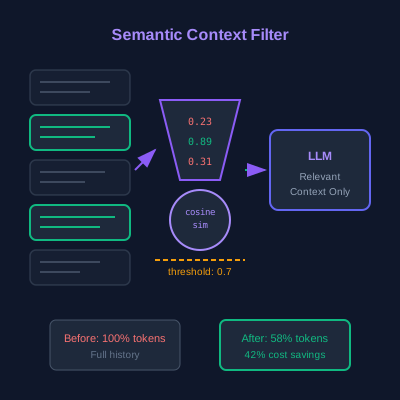
- Challenge: Managing conversation history across sessions while staying within token limits
- Solution: Designed DynamoDB-based persistence with intelligent context pruning, keeping only last N turns plus user profile, reducing context size by 60% while maintaining conversation quality
4. Multimodal Input Processing
- Challenge: Handling varied image inputs (product photos, receipts, fridge scans) with inconsistent quality
- Solution: Implemented preprocessing pipeline with image compression and quality validation, added fallback to text-based search when image recognition confidence is low
5. Production Observability
- Challenge: Debugging non-deterministic LLM behavior in production with 200K users
- Solution: Built comprehensive tracing with Opik and OpenTelemetry, capturing full conversation flows, tool calls, and latency breakdowns, enabling rapid issue identification and resolution
6. Cost Management at Scale
- Challenge: OpenAI API costs could spiral with high user engagement
- Solution: Implemented smart caching for repeated queries, optimized system prompts, and used streaming to show partial results while reducing perceived latency
My Role
Led ML engineering efforts for the agentic system with end-to-end ownership:
- Architected the dual-service system (Go API gateway + Python agent backend)
- Built LangGraph-based agent framework with streaming support
- Integrated OpenAI Responses API for advanced reasoning capabilities
- Implemented MCP tool wrappers for internal API access
- Deployed production infrastructure on AWS (ECS, DynamoDB, Secrets Manager)
- Designed conversational system prompts (4 major iterations v1-v4)
- Established comprehensive testing suite (pytest, moto for AWS mocking)
- Set up observability pipeline (Opik tracing, CloudWatch, Grafana metrics)
- Built product card system spanning agent logic, tool orchestration, multi-source enrichment (SERP API, catalog search, CDN images, Fetch points), and shoppable product cards enabling users to shop and earn rewards directly from the conversation, with infrastructure that also serves as the foundation for the Direct Messages feature
- Built image normalization pipeline processing 4.2M product images at 18x cost efficiency ($1,633 vs $30K projected), combining computer vision with LLM-based quality review
- Built end-to-end LLM evaluation system -- a continuous improvement loop connecting offline evaluation (golden dataset for experimentation), online evaluation (production trace monitoring), and human annotation (judge calibration loop where human feedback improves judges, which improves the dataset, which improves the agent), with CI/CD deploy gating that blocks releases on quality regression
Key Achievements
- 200K users - Successfully shipped to external users on iOS via V2.1 holdout experiment
- Continuous improvement loop - Evaluation system connecting offline eval, online monitoring, and human annotation in a self-improving feedback cycle
- CI/CD quality gating - Mandatory deploy gate validating every release against health scores; no automated quality gate existed before
- 4.2M images processed - Image normalization pipeline at 18x cost efficiency powering product cards
- 5+ MCP tools - Seamless shopping experience with offers, products, history, location, web search
- Extensible by design - Team can modify agent behaviors, evaluation criteria, and tools without changing core code
- Production observability - End-to-end visibility from LLM traces through production metrics via Opik, OpenTelemetry, and Grafana
Technologies
AI/ML: LangChain, LangGraph, OpenAI GPT-5-mini, OpenAI Responses API
Backend: Python, Go, FastAPI
AWS: ECS/Fargate, Lambda, DynamoDB, Secrets Manager, Cloud Map
Infrastructure: Docker, OpenTelemetry, CloudWatch, Grafana
Tools: MCP (Model Context Protocol), ReAct Pattern
Testing: Pytest, Moto, OpenAI Evals
Observability: Opik, CloudWatch, Grafana
Impact
Business Impact:
- First Consumer-Facing AI Agent - Pioneered Fetch's entry into conversational AI, powering a 200K-user holdout experiment
- Enhanced User Engagement - Positive user reception and growing adoption
- Increased Shopping Efficiency - Users discover personalized offers and products 3x faster than manual browsing
- Revenue Enablement - Drives higher engagement with 300+ retail partners through intelligent offer discovery
- Platform Differentiation - Establishes Fetch as an AI-first shopping rewards platform
Technical Innovation:
- Production-Scale AI - Sub-second latency (p95 < 800ms) serving 200K users
- Self-Improving Evaluation - Continuous feedback loop where human annotations calibrate judges, which improve the dataset, which improves the agent
- Extensible Architecture - Config-driven system where agent behaviors, evaluation criteria, and tools are modified without changing core code
- Modern AI Stack - Early adopter of OpenAI Responses API, LangGraph state machines, and MCP tool protocol
- Dual-Service Design - Go API gateway + Python agent backend enabling independent scaling and deployment
- End-to-End Observability - Opik (LLM tracing), OpenTelemetry (HTTP metrics, token usage), Grafana dashboards
Strategic Value: Unlike internal tooling projects (product matching, annotation, NER), this assistant directly touches end-users and represents a strategic shift toward AI-powered user experiences. The project demonstrates full ownership from architecture through deployment, setting the foundation for future consumer AI initiatives at Fetch.
Screenshots
Welcome screen with intelligent prompt suggestions for shopping queries
AI-generated $50 pantry stock-up list with 14 personalized items
Product offer cards with Fetch points, pricing, and visual recommendations